



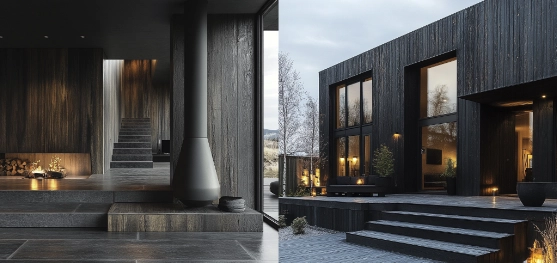
Is Charred Wood Actually Good for Exterior Use?
Preserving Wood with Fire
SHOU SUGI BAN or YAKISUGI is a traditional Japanese wood-charring technique used for centuries. It utilizes "flames" to alter the physical and chemical properties of the wood. By charring the surface, the natural wood grain becomes significantly more defined and prominent.
The Artistic Evolution
Initially, Japanese carpenters used fire as an artistic tool to bring innovation to woodworking. This ranged from:
Lightly Brushed: Charring only certain parts to highlight the grain.
Heavily Brushed: Charring the entire surface until it becomes deep black.
Global Popularity and Architectural Benefits
Over time, this technique gained widespread popularity worldwide, particularly in Europe and America, where it is frequently used in architecture and design. The preference for charred wood stems from several key factors:
Natural Preservation: It is a traditional, cost-effective, and non-toxic method of wood treatment.
Stability: It reduces the expansion and contraction of wood caused by sunlight and weather fluctuations—a critical factor for large woodwork, especially Charred Slabwood.
Durability and Protection
Charring the wood surface significantly extends its lifespan, often reaching 80–100 years. Unlike traditional wood stains, the blackened carbon layer does not peel or fade and requires far less maintenance.
Furthermore, the process acts as a natural deterrent against termites and wood-boring insects. The charred exterior creates a protective barrier that makes it much harder for pests to penetrate and consume the inner wood.
SHOU SUGI BAN is considered a classic technique that uses "fire to protect wood from fire." Fundamentally, wood consists of two primary components: Cellulose and Lignin.
Cellulose: The part that grows into the trunk, branches, and leaves.
Lignin: The structural tissue that provides strength and durability, which increases as the tree ages.
The Science of Charring
When wood is ignited, the softer cellulose is highly flammable and burns away first. In contrast, lignin takes much longer to catch fire. Furthermore, once the outer cellulose layer is burned off, the remaining charred lignin acts as a natural fire retardant. If one were to try and ignite the wood again, it would require much higher temperatures and longer exposure because the easily combustible elements have already evaporated and turned to char.
The Production Process
The process of creating a Charred Slab follows these essential steps:
1. Preparation: Clean the surface and plane the wood to the desired level.
2. Charring: Apply the flame to the wood surface to achieve the desired pattern or a full-char finish.
3. Cooling: Cool down the charred wood to stabilize the material.
4. Brushing: Scour the surface to make the grain patterns more prominent and distinct.
5. Cleaning: Remove excess soot and debris.
6. Finishing: Apply a protective coating as the final step before assembly.
Material Selection
Choosing the right material is vital. For instance, American Pine—specifically varieties that are hardwoods with striking grain patterns—is highly popular. It offers the classic beauty of pine while maintaining high durability. When subjected to the charring process, these characteristics combine to create a unique, aesthetically stunning, and one-of-a-kind piece of wood.